It added that industrial output is on decline due to poor demand and lack of infrastructure.

The Reserve Bank on Friday said India is poised to become the growth engine of the world as it retained the GDP projection for the current fiscal at 6.5 per cent. Unveiling the bi-monthly monetary policy review, Reserve Bank of India (RBI) Governor Shaktikanta Das said the domestic economy exhibits resilience on the back of strong demand.

The RBI has already hiked interest rates 12 times since March, 2010, to control inflation, which is currently hovering near the double-digit mark.

Foreign investors continue to show confidence in the country's equity market, infusing Rs 18,620 crore so far this month, driven by a combination of global tailwinds and improving domestic fundamentals. This positive momentum follows a net investment of Rs 4,223 crore in April, marking the first inflow in three months, data with the depositories showed.

S&P Global Ratings on Wednesday upgraded India's sovereign rating outlook to positive from stable while retaining the rating at 'BBB-' on robust growth and improved quality of government expenditure. S&P said it could upgrade India's sovereign rating in the next 2 years if the country adopts a cautious fiscal and monetary policy that diminishes the government's elevated debt and interest burden while bolstering economic resilience.

No experts, clearly, were involved in the design of these new tariffs, which have been the subject of bemused wonderment across the world in how completely they ignore logic, rationality, fairness, and economic theory, observes Mihir S Sharma.

A Kotak research report expects RBI to cuts rates by 50 basis points in the first half of 2019. RBI will announce its sixth bi-monthly monetary policy on February 7.

Borrowers should consider switching from an MCLR-linked to a repo rate-linked loan.

The retail inflation eased to a four-month low of 4.87 per cent in October, mainly due to cooling prices of food items, government data showed on Monday. The Consumer Price Index (CPI) based retail inflation fell to a three-month low of 5.02 per cent in September. The previous low inflation was recorded at 4.87 per cent in June.

The rupee tumbled 3 per cent against the US dollar in 2024 as concerns over slower economic growth and a stronger greenback in global markets weighed, but it was among the least volatile currencies in the world and the headwinds may be less intense in the coming year.

S&P Global Ratings on Tuesday cut India's GDP growth projections to 6.5 per cent for the next fiscal as it expects that economies in the APAC region will feel the strain of rising US tariffs and pushback on globalisation. In its Economic Outlook for Asia-Pacific (APAC), S&P said despite these external strains, it expects domestic demand momentum to remain solid in most emerging-market economies.

While the new income tax law replaces the Income Tax Act, 1961 and omits 13 offences, 35 actions and omissions continue to attract criminal liability under 13 provisions.

What appeared to be a generous act of friendship was, in truth, a manoeuvre within a much larger strategic game. The United States used the 1962 war not just to aid India but to test how far it could be pulled into the Western fold, points out Dr Kumar.

Wholesale price inflation eased to 2.05 per cent in March, as against 2.38 per cent in February, government data showed on Tuesday. The wholesale price index (WPI) based inflation, however, rose year-on-year.

Reserve Bank of India (RBI) is unlikely to cut the benchmark interest rate at its upcoming monetary policy review meeting, taking place soon after the announcement of the Lok Sabha election results, amid inflation challenges, said experts. The Monetary Policy Committee (MPC) may also refrain from rate cut as economic growth is picking up, notwithstanding the elevated interest rate of 6.5 per cent (repo) prevailing since February 2023. The meeting of the Reserve Bank Governor Shaktikanta Das headed MPC is scheduled for June 5 to 7.

While several key economic legislations, including insurance and PFRDA bills, are pending in Parliament, the government had to recently put on hold its decision to open the multi-brand retail sector to foreign investors.
With concern on food inflation ebbing with the monsoon progressing well, the Reserve Bank of India (RBI) is warming up to the idea of a change in stance to "neutral" from "withdrawal of accommodation", according to economists. In his speech on Thursday during the annual event of the Federation of Indian Chambers of Commerce and Industry-Indian Banks' Association, RBI Governor Shaktikanta Das said: "The balance between inflation and growth is well-poised."

Stock markets would take cues from the biggest event of the week -- the US Fed interest rate decision, besides tracking the trends in global markets and trading activity of foreign investors, analysts said. Last week, a heavy decline in smallcap, midcap firms, foreign fund outflows and elevated crude oil prices in the international market dented investors' sentiments. Experts said equity markets may remain volatile in the near-term amid a host of global central bank's monetary policy decisions lined up during the week.

An article on 'State of the Economy' in the monthly Bulletin also said the improvement in the outlook for agriculture and the revival of rural spending have turned out to be the bright spots in the evolution of demand conditions. Consumer price inflation ticked up in June 2024 after three consecutive months of moderation as a broad flare-up in vegetable prices halted the overall disinflation that had been underway, it said.

The Reserve Bank of India on Friday decided to keep the policy rate unchanged at 6.5 per cent for the fifth time in a row as it maintains a tight vigil on inflation. The rate increase cycle was paused in April after six consecutive rate hikes, aggregating to 250 basis points since May 2022. Announcing the bi-monthly monetary policy, RBI Governor Shaktikanta Das said the Monetary Policy Committee (MPC) unanimously decided to keep the repo rate unchanged at 6.5 per cent.

Widespread use of crypto assets, including stablecoins, can have a negative impact on the macroeconomic and financial stability of a country, the Reserve Bank of India (RBI) said on Monday. In its Financial Stability Report (FSR), the banking regulator highlighted that excessive use of crypto assets can reduce effectiveness of monetary policy, worsen fiscal risks, circumvent capital flow management measures, divert resources available for financing the real economy and threaten global financial stability.

India's manufacturing sector growth eased slightly in July, on softer increases in new orders and output, while cost pressures and demand strength led to the steepest increase in selling prices since October 2013, a monthly survey said on Thursday. The seasonally adjusted HSBC India Manufacturing Purchasing Managers' Index (PMI) moderated slightly from 58.3 in June to 58.1 in July.
The government has invited applications for the post of deputy governor of the Reserve Bank of India (RBI) from interested candidates with at least 25 years of experience and below 60 years of age as on January 15, 2025. One of the deputy governors, Michael Patra's current term will end on 15 January. The last date of submission of applications is November 30, 2024.

'...not merely in managing fiscal mathematics, but in demonstrating conservatism and prudence within that framework.' 'Looking forward, we believe sufficient growth drivers exist -- ranging from government reforms to revival in consumption to favourable monsoons. Numerous factors support the Indian economy.'

'Other sectors that manage the savings pools of Indians are giving tough competition to life insurance companies.'

The Gems and Jewellery Export Promotion Council (GJEPC) has urged the Centre to provide immediate relief measures as the tariffs imposed by the United States have started hitting the industry. US tariffs of 50 per cent on Indian goods came into effect on August 27.

As a protege of Shinzo Abe, Takaichi is expected to scale bilateral ties much higher. Trade and investment shall grow. People-to-people contacts shall be scaled up, points out Dr Rajaram Panda.

The Reserve Bank of India on Friday revised upwards the GDP growth projection for the current fiscal to 7.2 per cent from 7 per cent on rising private consumption and revival of demand in rural areas. Unveiling the bi-monthly monetary policy, RBI Governor Shaktikanta Das said estimates released by the National Statistical Office (NSO) placed India's real gross domestic product (GDP) growth at 8.2 per cent in 2023-24. "During 2024-25 so far, domestic economic activity has maintained resilience," he said, adding that manufacturing activity continues to gain ground on the back of strengthening domestic demand.

The Reserve Bank of India's interest rate decision, macroeconomic data and global trends will drive investors' sentiment this week, with markets hoping to continue the positive momentum after ending FY24 on a buoyant note, analysts said. In addition, the trading activity of foreign investors, the rupee-dollar trend and the movement of global oil benchmark Brent crude would also influence trading in equity markets. The 30-share BSE Sensex climbed 14,659.83 points or 24.85 per cent in the 2023-24.
Reserve Bank on Thursday retained the growth and inflation projection at 7.2 per cent and 4.5 per cent respectively for the current fiscal amid expectations of a normal monsoon. In its last bi-monthly monetary policy review in June, RBI had projected real GDP growth and retail inflation at the same.

In the Sensex pack, Hero MotoCorp, IndusInd Bank, Bajaj Auto, Maruti and M&M were the top gainers, spurting up to 2.66 per cent.

Amid the ongoing global tariff war, Reserve Bank Governor Sanjay Malhotra on Wednesday said he is more worried about its impact on growth than inflation. Speaking to the media after presentation of the first bi-monthly monetary policy for the current financial year, Malhotra said, RBI has reduced the growth forecast for 2025-26 by 20 basis points to 6.5 per cent.

Despite sharp interest rate cuts expected in this financial year amid easy liquidity conditions, state-run banks are treading cautiously on their loan growth projections for FY26. Most large banks are projecting loan growth at 11-13 per cent, almost similar to the previous financial year.
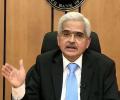
Reserve Bank of India (RBI) Governor Shaktikanta Das has said the decision on interest rate moderation will be based on long-term inflation trajectory and not monthly data. The Monetary Policy Committee (MPC) headed by the RBI Governor is scheduled to meet between October 7 and 9 and take call on interest rate. The RBI kept the repo rate unchanged at 6.5 per cent for the ninth time in a row amid risks from higher food inflation.
The central bank's next monetary policy review is scheduled for April 5. It had kept the policy rate unchanged in its February meeting on fears of inflation.
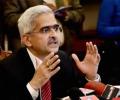
All members of the Monetary Policy Committee (MPC) -- Shashanka Bhide, Ashima Goyal, Jayanth R Varma, Mridul K Saggar, Michael Debabrata Patra and Shaktikanta Das -- had unanimously voted to keep the policy repo rate unchanged at 4 per cent after the three-day meet of the panel earlier this month. Further, except Varma, other members voted to continue with the accommodative stance as long as necessary to revive and sustain growth on a durable basis and continue to mitigate the impact of COVID-19 on the economy, while ensuring that inflation remains within the target going forward. Varma expressed reservations on this part of the MPC resolution, according to the minutes.

The liquidity deficit in the banking system crossed Rs 2 trillion again on Monday, despite the second instalment of cash reserve ratio (CRR) reduction coming into effect from December 28.

The equity benchmark indices posted their strongest weekly gains in years, driven by bargain hunting and optimism over a reversal in foreign portfolio investor (FPI) outflows. The Sensex rose 558 points, or 0.7 per cent, on Friday to close at 76,906, while the Nifty 50 gained 160 points to end at 23,350. Over the past five sessions, both indices advanced around 4.3 per cent - marking the Sensex's best weekly performance since July 22, 2022, and the Nifty 50's strongest rally since February 5, 2021.

Led by a sharper-than-expected deceleration in industrial activity, economic growth in India slowed more than anticipated and is projected to remain at 6.5 per cent till 2026, the International Monetary Fund said on Friday. "Growth in India slowed more than expected, led by a sharper-than-expected deceleration in industrial activity," the IMF said in its latest update of the World Economic Outlook, according to which the global economy is holding steady. In 2023, India's growth rate was 8.2 per cent, which dropped to 6.5 per cent in 2024.

Sri Lanka stays with you not just in memory, but gently reminds you what a society can achieve when heart and heritage guide the way.
